
Cheesecake
by Mark Kurlansky

I learned a new term over the holiday: self-gentrification.
It’s when a member of a particular community buys into their own neighborhood, through real estate and business acquisition for the betterment of that neighborhood.
When I came across the term it was being used to describe what Majora Carter, a Bronx native, did (does?) in her childhood neighborhood of Hunts Point.
Not everyone saw her attempt at self-gentrification as a positive thing, of course. In the article I read, she was accused of commodifying or commercializing the Bronx. Carter opened Birch Coffee, a boutique coffee shop in Hunts Point, in 2016. Since then, the main complaint seemed to be that she was pricing out longtime residents —gentrification’s major flaw.
“Hunts Point is New York’s least promising place to grow up.” according to the Citizens Committee for Children of New York, yet Carter introduced a cafe complete with exposed brick walls and a “fabulous, kick ass espresso machine” to add an opportunity for an indulgence in the community.
I don’t have all the facts and vantage points so I’m not in a place to give heavy criticism, so I’ll just offer general criticism. Gentrification, driven by anybody, will not be the answer if the long-standing members of the communities are being pushed out. I don’t know the solution. But I am curious about Majora Carter’s motivations.
The article mentioned how she grew up in the 70s, “the Bronx is burning” era and how her family struggled financially at times. She does own a few other companies, but maybe she just wanted to plant a caffeinated oasis in Hunts Point.
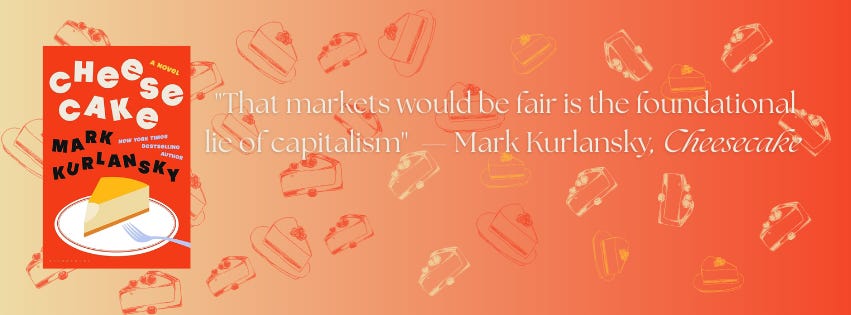
Pondering all of this made me think about one of the latest books I read toward the end of 2025, Cheesecake by Mark Kurlansky.
“Romans sought conquest, not community.” — Mark Kurlansky, Cheesecake.
Like Majora Carter, the main character, Art, opened a shop in a New York neighborhood. What were his motivations? Righting an impoverished past? Wanting to build a legacy?
The story is set in New York’s Upper West Side, on West 86th Street, in the 1970s. With all its elements, it’s not unlike the ingredients list for cheesecake. I think the most captivating moments in the story are the sprinkles of food history dusted throughout.
The author, Mark Kurlansky, holds great authority in the realm of food history. He writes in a way that makes common consumables (like salt) worth reading 400+ pages.
Essentially Kurlansky is a historian. And I love that he’s stepped away from non-fiction a few times to explore a more creative side. In Cheesecake, he explores the history of a neighborhood going through cultural shifts at the hand of gentrification.
The gentrification of a neighborhood told through cheesecake recipe interpretations. It’s clever.
It was as much about the love of cheesecake as it was about the love of the city. Some wanting to stick to tradition, following the rules and doing things the way they’ve always been. Some wanting to tweak it to their preference. Introducing new ingredients where needed, to improve the taste. OR changing the recipe completely and still naming it what it wasn’t.
Like Cato the Elder’s cheesecake recipe, gentrification is an old idea (not as ancient as Cato’s cheesecake but still…) that may not truly be a workable one. Sometimes things stand the test of time because they’re too obscure to fade.
The cheesecake of it all is a very tangible thing but beyond that are the intangibles (greed, ambition, family obligations, secrecy, debauchery) that make the book engaging. The theme just makes me sad. It happens all over America.
I’ve lived in a city while it was undergoing a wave gentrification. It’s disheartening, to say the least. I’ve seen an entire neighborhood have its homes, school, etc. either picked up & relocated or completely demolished.
Gentrification creates a chasm. That idea is explored in this tangent about New York:
I fear, we were always careening in this direction, and not much would have been/could have been done to stop it. Pessimistic, I know. But…things change.